
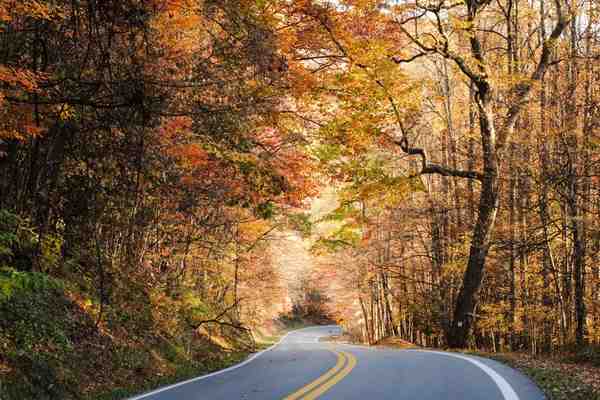
There is something wonderfully simple about planning a trip around the changing leaves. You do not need a packed sightseeing schedule. You need a reliable car, a flexible route, and enough time to pull over when a mountain ridge, lakeshore, or maple-lined village catches your eye. The best fall foliage road trips turn the journey into the main attraction, combining scenic highways with small towns, overlooks, waterfalls, and crisp-air walks.
Autumn color never follows an exact calendar. Elevation, rainfall, temperature, and wind can all shift peak conditions. Northern states and high mountain areas usually change first, while lower elevations farther south may hold color into late October or early November. Use the windows below for planning, then check local foliage reports and road conditions shortly before departure.
Kancamagus Highway, New Hampshire
For classic New England scenery, few fall foliage drives are as satisfying as the Kancamagus Highway. Route 112 runs for about 34 miles between Lincoln and Conway through the White Mountain National Forest. The central section has no busy commercial strip, leaving forested slopes, rocky rivers, mountain passes, and overlooks to set the pace.
Allow several hours rather than treating it as a quick crossing. Stops such as Pemigewasset Overlook, Sabbaday Falls, and the Swift River invite you out of the car. Color often develops from late September into early or mid-October. Weekdays and early mornings are especially useful during peak season.
Route 100, Vermont
Vermont Route 100 is the road people imagine when they picture autumn in rural New England. It traces the Green Mountains through farms, forests, ski towns, and villages where church steeples rise above red and gold trees. Build a weekend around Stowe and Waterbury or follow a longer section through Killington, Ludlow, and Wilmington.
The appeal is the rhythm of the journey rather than one viewpoint. Covered bridges, farm stands, trails, and cafés make spontaneous stops easy. Early to mid-October is a common target for central and northern Vermont, while southern areas may change later.
Blue Ridge Parkway, Virginia and North Carolina
The Blue Ridge Parkway is one of the most versatile autumn road trips in the country. Its long route and dramatic changes in elevation create a rolling foliage season instead of one brief peak. Higher areas may begin turning in late September, while much of the route develops through October.
You do not need to drive all 469 miles. Choose a section near Shenandoah, Boone, Blowing Rock, Asheville, or Great Smoky Mountains National Park. Frequent overlooks and short trails make it easy to customize the day. Allow extra time, watch for cyclists and wildlife, and check for temporary closures before leaving.
Great Smoky Mountains, Tennessee and North Carolina
The Smokies suit travelers who cannot commit to one exact peak weekend. Because the park rises from low valleys to high ridges, fall colors move downhill over several weeks. Higher elevations may change in September, while mid and lower elevations often look their best from mid-October into early November.
Foothills Parkway offers broad mountain views, while Lakeview Drive feels quieter and more wooded. Cades Cove Loop Road and Roaring Fork Motor Nature Trail are beautiful but can become extremely busy. Start early, expect slow traffic, and keep a backup route.
San Juan Skyway, Colorado
Colorado offers a different autumn palette, with golden aspens set against dark evergreens and rugged peaks. The San Juan Skyway forms a 236-mile loop through southwestern Colorado, connecting Durango, Silverton, Ouray, and Telluride.
This is one of the most dramatic options for leaf peeping USA travelers, but it requires confident mountain driving. Some sections are steep and winding, and weather changes quickly at elevation. Aspen color often appears from mid-September into early October. Give the loop at least two or three days so you can enjoy its towns and viewpoints without rushing.
Keweenaw Peninsula, Michigan
Michigan’s Upper Peninsula combines hardwood color with the deep blue of Lake Superior. Follow M-26 and M-41 around the Keweenaw Peninsula for historic mining communities, forest roads, shoreline views, and small harbors. A detour to Brockway Mountain Drive adds a high viewpoint over miles of autumn forest.
The Upper Peninsula usually changes earlier than southern Michigan, commonly from late September into early October. Services can be widely spaced, so keep the fuel tank comfortably full. This route is ideal for travelers who prefer cooler weather and quieter roads.
Mount Hood Scenic Byway, Oregon
For a Pacific Northwest alternative, travel through the Columbia River Gorge, Hood River Valley, and the forested slopes around Mount Hood. The byway follows OR-35 through orchard country before climbing into mountain landscapes, while nearby gorge routes add waterfalls and river viewpoints.
Oregon’s color is less predictable than New England’s concentrated maple display, but vine maples, cottonwoods, orchards, and mixed forests can produce beautiful scenes from late September through October. Add the Hood River County Fruit Loop for seasonal produce, farm stops, and mountain views on clear days.
How to Plan Around the Best Time for Fall Colors
Treat timing as a range, not a promise. Choose a region that normally changes during your available dates, then monitor its official foliage tracker about a week before departure. Elevation provides a useful backup: if high ridges are past peak, lower valleys may still be bright; if valleys remain green, climb higher.
Book accommodation early in famous foliage areas, but avoid scheduling every hour. Pack layers, rain protection, water, and offline maps. Drive slowly, use designated pullouts, and never stop in a traffic lane for a photograph. The best fall foliage drives balance preparation with freedom to follow the color.
Frequently Asked Questions
What are the best fall foliage road trips for first-time visitors?
The Kancamagus Highway, Vermont Route 100, and a selected section of the Blue Ridge Parkway are excellent first choices. They combine recognizable scenery with frequent stops, nearby towns, and flexible route lengths.
When is the best time for fall colors in the USA?
Color can begin in northern and high-elevation areas in mid or late September and continue in lower southern regions into early November. Early to mid-October offers the broadest range of possibilities, but local reports are more reliable than fixed dates.
How many days should an autumn road trip take?
A focused scenic byway can work as a one-day trip, while longer routes are better over three to seven days. Slower itineraries leave room for weather changes, traffic, walks, viewpoints, and unexpected stops.
How can I avoid crowds during peak foliage?
Travel on weekdays, begin early, stay overnight near the route, and explore less famous sections of popular regions. Visiting just before or after predicted peak can still provide excellent color with lighter traffic.
Conclusion
The best fall foliage road trips are not about chasing one perfect peak day. They are about watching the landscape change mile by mile, from mountain aspens to New England maples and southern Appalachian forests. Choose a route that fits your dates, check current conditions, and leave room for detours. Autumn rewards travelers who slow down and enjoy the road as much as the destination.